By Stefán Jóhann Sigurðsson
From the Blog to Brooklyn: The Rise of Zara Larsson
How a Swedish teen blogger became a U.S. headliner without getting any quieter, and what that tells brands about the price of speaking up.
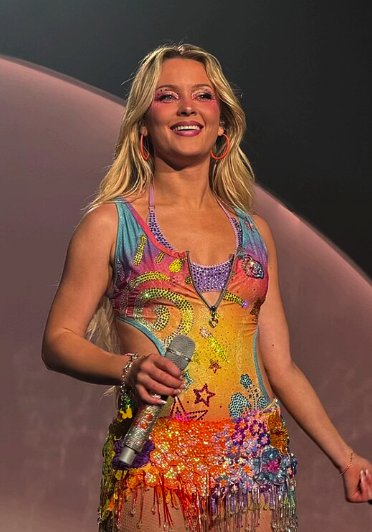
As a former teen blogger with an unrelenting need to explain my innermost thoughts with nary a suggestion from the audience, it feels apt to put these blogging fingers back to work with a deep dive into one of my lifelong passions: women in music.
Over the last few years I’ve been fascinated by my Nordic sister, Sweden’s own Zara Larsson. Namely, her career growth from European EDM songstress to U.S. headliner, the consistency she moves with through every phase and how she, along with some impressive cohorts, now challenges our shared notion of what being a person in public life means.
I've been obsessed with pop and R&B music since I was a kid, plus Zara’s a Nordic girl going for it in the U.S., so I've watched her trajectory closely and feel a wonderful, albeit parasocial, kinship with her. What I appreciate is not just what she’s accomplished but how.
I recently rewatched her documentary, Zara Larsson - Up Close, directed by Lise Bergvall, and released on Prime Video almost exactly one year ago. The documentary covers Zara’s life and career up to the release of her album Midnight Sun in September 2025. Much like how it recently took months to uplift Tinashe, the album took some weeks to catch fire. Zara toured Europe through the end of the year, and by the time she reached the U.S. in early 2026, it was everywhere. Watching the film now, knowing what came next, is really satisfying because the documentary was bold. She was betting on herself.
Before one of two sold-out tour stops at the Brooklyn Paramount this past March, Zara sat down with fans in the theater's gilded hall for an intimate acoustic set. The New York Times was there for a profile and in the post-set Q+A, a young fan wanted to know how Zara had become "the perfect star." She would be the first to tell you that she is anything but, and she is refreshingly candid about this in Up Close.
She won Sweden's Got Talent at ten and subsequently made the rounds at American record labels, with no deals at first. Then she had global hits by seventeen with "Lush Life" and "Never Forget You," a duet with artist MNEK. What followed were years of singles that never quite landed with audiences, leaving her stuck in the infamous Khia Asylum, a fictional online limbo for artists whose songs everyone knows without knowing the artists. As Zara describes in Up Close: "A lot of people know the songs. They don't know I sing them. I've got the hits, but I've got no cultural relevance."
The documentary doesn't shy away from how much was riding on Midnight Sun. In one scene set in NYC, Sylvia Rhone, then chair and CEO of Epic Records, asks Zara whether she feels the pressure. "Yes, I feel like I have a lot to prove. And I feel like 'oh it's go time,' I have to go and I have to be fucking amazing." Zara says. Rhone isn’t playing around either: "I feel the pressure of it too. It's 'go time' for everybody." The label has put years into this "and now it's time to cash in."
Nobody wanted to win more than Zara and she had a clear vision of what that victory looked like, drawing inspiration from her idol Beyoncé: "I want this to be amazing. That's what I want. I want the hit record so I can have the full production. No limits, we can do whatever we want. Full band, full dancers, full whatever it is." After her 2021 album, Poster Girl, stalled, Rhone candidly asked her who she was as an artist and what kind of music she wanted to make. She didn’t have an answer. She spent the next few years searching and put out her fourth studio album, Venus, in 2024, the first project under her own label, but it was with Midnight Sun she found her answer.
By the end of the film she's in Los Angeles, playing the finished album to a room full of Epic executives, a crowd famous for everything but their enthusiasm. But when it ends, they applaud, and Rhone doesn't hold back: "We've been waiting on this a long time lady! It sounds amazing Zara, you killed it." Zara sums up the moment herself: "I've been struggling a bit to put my personality in the songs I'm singing but I feel on this project it came together." And if it hadn't worked? "I'll make another fucking album until it is a success [laughs]."
Midnight Sun marked Zara’s best chart run in the U.S., with two consecutive Grammy nominations in the bag and a sold-out North American tour. Late last year, she was featured on PinkPantheress’ single "Stateside," which went viral after Olympic gold medalist Alysa Liu skated to it at the Olympic Winter Games in February, and became her first U.S. top 10. "I feel like I'm out of the Khia Asylum for sure," she told Dazed.
What fascinates me most is that she didn't get to the top by becoming more careful. She got here by staying exactly who she has always been.
The old formula
Entertainment has long had an unofficial rule: if you want to be A-list, you don't give anyone a reason to switch you off. Keep your politics private, keep your image easy to like, and leave room for everyone. Most famous people still follow it, but a growing number are at the top of their fields without following it, and Zara is one of the clearest examples.
Girlhood is power
Zara's aesthetic is intentionally girly and playful on her own terms: glitter, dolphins, sequins, Y2K. When she wrote down what she wanted Midnight Sun to be, the list included "unapologetic" and "girlhood." Misogyny has coded contemporary culture to rule these aesthetics as unserious, unintelligent and uncool, creating a pit from which many artists struggle to escape in an already male-dominated industry. The “cool girl” stereotype in media and entertainment, at least how it has been drilled into us Millennials, is, in very simple terms, an effortlessly beautiful girl who shares the interests of the average man and, for no discernible reason, acts submissive and never gets upset. As a reminder, Gillian Flynn gave us a much more memorable definition in her novel Gone Girl, immortalized by Rosamund Pike in the film adaptation.
Zara absolutely refuses this narrative. Fellow Swedish singer and living icon Robyn pointed this out when the two sat down in Stockholm for Rolling Stone's Musicians on Musicians series this past October: Zara presents femininity and beauty in one breath, then talks about abortion rights in the next. She's been doing this since she was a teenager. In 2015, at 17, she told Dagens Nyheter that Bråvalla, then Sweden's biggest festival, was dominated by men, and questioned why she wasn't promoted the way her male peers were. She received an answer via a storm of online hate, and a label that stuck: controversial. But in reality, Zara was honing in on her values and when to stand on them.
Zara’s song "Hot & Sexy," from Midnight Sun, is a fascinating example of her multitudes. On the surface, the song is a party anthem for a girls’ night out: empowering, confident, and sexy. But as the song goes on, the lyrics reveal a deceptively simple plea to be free from the shadow of the male gaze. It reflects her refusal to be boxed in by anyone, including herself. Joy and critique are not mutually exclusive. In Up Close, she says: "To be personal doesn't always have to be like things that are hard… I want to be personal, but I also want people to dance." A particularly impassioned performance of the song’s last section has been circulating on TikTok in the wake of reporting on the Cornell 7.
As the self-appointed third guardian to a sister three years Zara’s junior, I remember very well the labor of building and protecting her confidence in a society that constantly dictated how she should look, behave and feel. The messaging nevertheless seems to seep through the cracks. How do we rationalize this to our sisters, nieces, mothers, and all of the other women who literally give us life? In what seems like a never-ending conflict against the patriarchy, I would have loved for her to grow up with someone like Zara to look up to: proud, powerful, and unapologetically a girly girl’s girl.
In 2022 she bought back her entire recording catalogue from TEN Music Group and launched her own label, Sommer House, which releases her new music through Sony. For Midnight Sun, the first album where she co-wrote every song, she went back to MNEK, her "Never Forget You" duet partner, to executive produce. She credits him with more than that. In Up Close, she says she wasn't even in the room when her early songs were written, until her "first ever ever ever session," where she wrote "Never Forget You" with him. "He opened the door for the songwriting world to me." He's a big part of why I am excited about a record before I've heard it. He’s written and produced for Beyoncé, my girls FLO, and most recently a new personal favorite Tyler Lewis, the first artist on his own label. He’s also a talented artist in his own right; his new album, BULLDOZER!!, is worth your time too. "Midnight Sun" earned her first "Best Dance Pop Recording" Grammy nomination, and "Blue Moon," the album’s fourth single, is up in the same category at February's Grammys. When her label floated entering her for Best New Artist last year, she shut it down: "That would downplay the 13 years of me being an artist. I'm not a new artist."
Values built on the blog
Zara's conversation with Robyn in Rolling Stone resonated with me in a lot of ways, particularly when Robyn brought up the culture shock of coming to America as a young Swedish artist and how much got lost in translation. I've spent more than 13 years in New York as an Icelander, and experienced the tribulations of mistranslation firsthand, sometimes the hard way but always for the better. Zara added to Robyn’s sentiments. America, she said, is individualistic in a way Sweden isn't. Sweden has a culture of "you're not better than anyone," while in America you're encouraged to be whoever you want. People who grew up in the Nordics know that rule of culture, the collective comes before the individual. It even has a name: the Law of Jante.
Robyn also asked Zara how she stays so vocal, and what it has cost her. Zara's answer goes back to a blog she started at 13 or 14. She wrote about her days and her outfits, started reading the news, got better at English, and argued with commenters, often answering them with whole posts and essays. That helped her solidify her belief system. She says the same thing in Up Close: "Growing up I just had to find my voice. What do I think is wrong, what do I think is right, what are my core values and beliefs." As she says it, the film puts her old tweets on screen beside her, and she sits next to them calmly, standing ten toes behind some of her arguably boldest remarks.
To put it plainly, she says: "In my world, I think to speak about whatever, abortions, immigrants, human rights, it doesn't feel like a big thing. But then you see it and you see the backlash and you're like, 'Oh, whoops.'"
It’s a great illustration of the cultural gap between the Nordics and the U.S. Positions that are commonplace in Stockholm read as a political statement in the U.S. I see similar challenges with Nordic brands breaking into American markets, especially New York: the values stay the same, but the way they're read changes. Navigating that requires cultural fluency that you can’t learn online.
The price is going down
Speaking up has not been free for Zara, and some of the costs are on the record. Robyn brought up a deal Zara lost after talking about abortion. By Zara's account, it was the biggest brand deal she'd ever been offered, worth $3 million, pulled after she joked about abortion on TikTok. Her reaction: "I was genuinely like: OK, losers!" She has also spoken openly about the online abuse she's received for her feminism. She knew the risk going in.
The film is more blunt. "When I say, like, free Palestine, I have never been canceled like that before," she says. "I got pulled out of shows or canceled, like, award show performances, like, deals taken from me… That shook me a bit because I've never felt that before."
A year ago, a Dagens Nyheter critic sounded nostalgic for the days when "the feminist from Tallkrogen" was one of Sweden's most outspoken pop stars, implying Zara had perhaps softened up. Two months later, she was blasting ICE. The White House responded to her criticisms with a TikTok set to "Lush Life," and later used "Midnight Sun" in a video celebrating deportations, which she called dehumanizing. For an artist who made a point of owning her music, I can only imagine the symphony of expletives that left her lips when she found this out. Within days of her response, the song had gone silent on the White House's video: "This sound is unavailable."
In September, after fans raised the UAE's perceived role in the war in Sudan, she said she wouldn't play the Abu Dhabi Grand Prix concerts in December. The organizer replaced her with Kings of Leon, without giving a reason. It wasn't the first big stage she'd turned down. In 2024 she declined an invitation to perform during the Eurovision broadcast in Malmö, in protest of Israel's participation. "I didn't feel good being a part of that," she told Dazed. Up Close catches the moment she’s faced with a decision, in the middle of a studio session. "It's a good opportunity," she says to her manager. "It's really annoying in my body because I don't feel excited about it."
It’s worth noting that none of it derailed her. The cost of speaking up is still real, but it's falling, and every person at the top who pays it anyway makes it cheaper for the next one in line. Zara sees it the same way: "You have to speak out about things, because it means other people are less scared to," she told Dazed. Zara isn't an outlier. Others at the very top of entertainment have decided the same costs are worth paying. Actors Mark Ruffalo, Florence Pugh and Hannah Einbinder have become staunch public advocates of human rights in our divisive times, as have major pop stars like Dua Lipa and Olivia Rodrigo.
Why we now expect more
What has become increasingly clear to me are the ways in which hyper-individualism has diluted our collective consciousness and our capacity for empathy. However, fan bases are becoming more aware of the power they hold as stakeholders platforming artists and their work. Audiences crave community, and they want to be in community with those with aligned values. In September, Macklemore said "Free Palestine" on stage while opening for Ed Sheeran at MetLife Stadium. Days later, the tour's promoter said venues had refused to allow shows with Macklemore on the bill, and he was dropped. Sheeran said it was the promoter's decision and that he wouldn't be drawn into a debate about Gaza. His tour band and every one of his remaining support acts then quit the tour in solidarity with Macklemore, Finneas and the Danish band Lukas Graham among them, and some radio stations, notably in Ireland, pulled Sheeran's music. Zara, for her part, publicly praised Macklemore for continuing to speak up.
What I see is that the middle ground, which used to be the safe place, set off more backlash than a clear position in either direction probably would have. People can tell the difference between "I believe this" and "I'd rather not say."
Nobody needs a celebrity hot take on every headline. What audiences want is honesty and consistency: say what you believe, and don't drop it when it gets inconvenient. The old rule assumed silence was neutral. More and more, people read it as a choice.
No more pedestals
I think we’re collectively beyond putting people on pedestals and Zara doesn't put herself on one either. You cannot be everything to everyone all the time and she knows that. In Up Close, while touring in the U.S. she’s asked whether she'll speak out against Trumpism. At that moment, she isn't sure she has it in her: "I can't be up all night replying to angry people and getting anxious about the world and the state the world is in."
Relatable, honestly. The film then cuts to her on stage, where she lands on something tangible: a jar by the merch stand, "to make sure abortions are safe and legal in other states that are not as beautiful and open minded as New York." Sometimes that's the move. "I'm human and sometimes I feel insecure and I feel small," she later told Dazed. Robyn experienced pressure to be a perfect role model, but says Zara seems free of it while keeping her integrity. Zara replied: "I hope I can keep it that way."
What I respect is the pattern: she says what she thinks, listens when people push back, and owns it when she gets something wrong. When her first reply about Abu Dhabi came across as impulsive, she came back and said so.
What this means for brands
Nobody wants a company weighing in on every news cycle, and most of us are very tired of brands posting like they're people. The surveys still fluctuate: the latest Gallup and Bentley University poll found 47% of Americans want businesses to take public stances, down from 51% a year earlier. But the people paying attention to where their money goes still care whether a company's values hold up.
For brands, the lesson isn't to take a stand on everything: identify the causes that connect naturally to what you do, and hold to them when it gets uncomfortable. Zara's values show up in her choices and that's why her statements read genuinely. The Sheeran tour shows the other side: a neutral answer is still a choice.
Decide before you're asked. Know which issues connect to your business, what you're prepared to say, and what you'd be willing to give up. The middle ground is not a safe zone anymore, especially not in crisis.
If you're a Nordic brand coming to the U.S., expect your values to be read differently than they are at home. In Stockholm or Reykjavík, equality and climate policy can feel like background facts. In America, the same values can be read as a political position, to supporters and critics alike. Own them, but keep in mind how they may land before you launch.
New York owes her one
A year ago, what Zara wanted most was for people to know her and her music and think, "that's a cool girl," more than just "oh, I've heard her on the radio." As the recently uplifted Tinashe put so eloquently, "I have realized that I am the through line between all of my different interests and inspirations." Back then, Zara couldn't see the red thread running through her own world. Now, she embodies the cool girl we’ve needed (and had) all along.
Zara was supposed to headline All Things Go at Forest Hills Stadium in Queens this past September (her first-ever headlining festival set) but a nor'easter washed out the whole weekend. When she comes back to Queens, I'll be there, dolphin poncho in tow.